The figure of Leonardo da Vinci has always been shrouded in an aura of genius and mystery. Yet few people know that hidden among his sketches and notes lies a possible connection to the Upper Brembana Valley, in the province of Bergamo. This intriguing link is revealed by Emilio Moreschi, an enthusiastic scholar who presents a fascinating and well-documented reconstruction of it in Quaderni Brembani 18.
Leonardo’s Sketches and the Brembana Valley
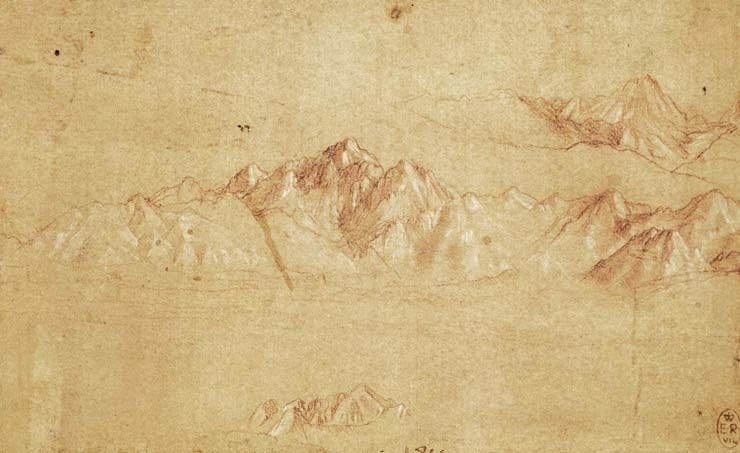
The core of Moreschi’s investigation is based on a series of drawings preserved in the Royal Library of Windsor, attributed to Leonardo da Vinci and depicting alpine landscapes. In particular, reference is made to a group of sketches titled: “Mountain villages on a valley, village Aipner, Val Brembana, circa 1495–1498.”
As Moreschi points out, the phrase “Val Brembana” appears explicitly on the back of one of these drawings—likely added at a later date by a scholar, but still indicative of a certain interpretive direction. Known for his travels and insatiable curiosity about nature, Leonardo may well have ventured into the Bergamo Alps during one of his journeys through northern Italy between 1495 and 1498, a period when he was living in Milan under the service of Ludovico il Moro.
Moreschi writes:
“It cannot be ruled out that Leonardo, fascinated by the Lombard mountains, actually visited the Brembana Valley, reaching the foothills of the Orobie Alps to study their geology and water patterns—elements that frequently appear in his notes.”
The Mysterious Village of “Aipner”
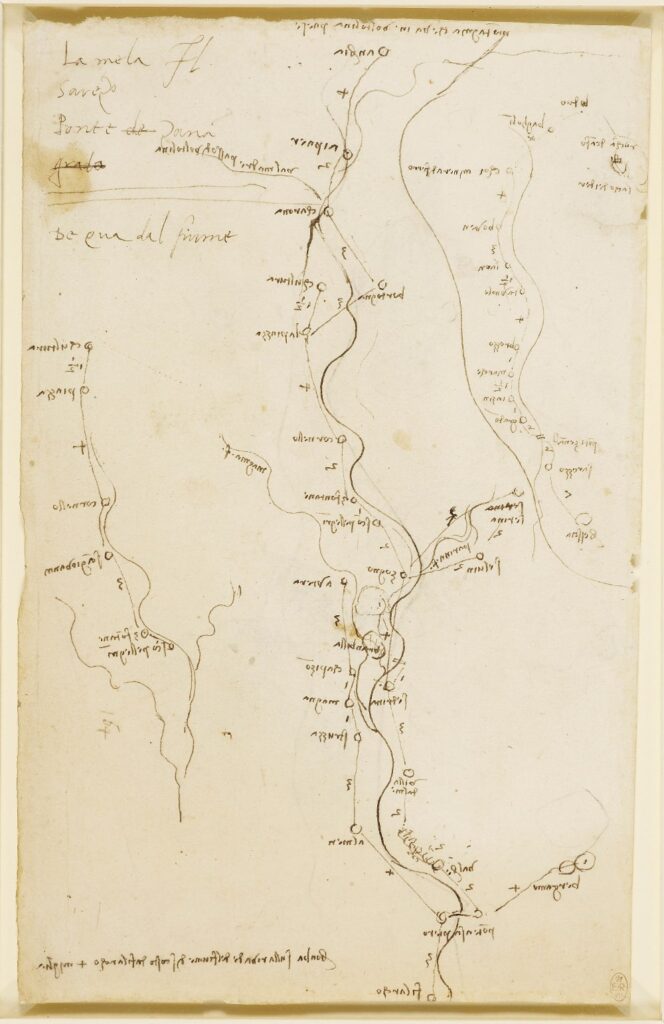
One of the most intriguing elements is the toponym “Aipner”, which accompanies the drawing. According to Moreschi, this could be a transcription or transliteration error, or perhaps a distortion of a local name that has since disappeared or changed. Although there is no definitive match with any current village, the hypothesis remains compelling and invites further historical and toponymic investigation.
The Mountains and Scientific Observation
Leonardo was not only drawn to the aesthetic beauty of landscapes, but also to the structure of mountains, watercourses, and natural phenomena. His observations on rock stratification, springs, and currents are consistent with features observable in the Upper Brembana Valley. The mountains, streams, and rock formations in this area would have provided an ideal setting for both his scientific inquiries and artistic studies.
Moreschi writes:
“The idea of Leonardo as an explorer of the alpine valleys is not just a romantic notion, but one that aligns perfectly with his empirical approach to knowledge.”
A Legacy to Rediscover
Although there is no definitive proof of Leonardo’s physical presence in the Brembana Valley, the association of those drawings with the region opens the door to a potentially unexplored chapter of his life. In an era when Leonardo recorded and sketched every detail of nature with scientific precision, even a remote landscape like that of the Orobie could become a source of study and inspiration.
Emilio Moreschi’s contribution sheds new light on a captivating hypothesis: that Leonardo da Vinci may have set his gaze—and his pen—on the Upper Brembana Valley. It’s an idea that sparks curiosity and invites us to look at the Bergamo mountains with different eyes—perhaps even with the eyes of a Renaissance genius.